The Hundred Years' War was a series of conflicts waged from 1337 to 1453 between the House of Plantagenet, rulers of the Kingdom of England, against the House of Valois for control of the Kingdom of France. Each side drew many allies into the war.
For their French possessions, the English kings since the Norman Conquest were vassals of the kings of France. The French kings had endeavored, over the centuries, to reduce the possessions of their over-mighty vassals, to the effect that only Gascony was left to the English. The confiscation or threat of confiscating this duchy had been part of French policy to check the growth of English power, particularly whenever the English were at war with the Kingdom of Scotland, an ally of France.
Through his mother, Isabella of France, Edward III was the grandson ofPhilip IV of France, and nephew of Charles IV of France, the last king with direct lineage to the House of Capet. In 1316, a principle was established denying women succession to the French throne. When Charles IV died in 1328, Isabella, unable to claim the French throne for herself, claimed it for her son. The French rejected the claim, maintaining that Isabella could not transmit a right which she did not possess. The French denial of Edward III's claim to the French throne initiated the period of conflict between England and France now known as the Hundred Years' War. Several overwhelming English victories in the war—especially at Crecy, Poitiers, and Agincourt—raised the prospects of an ultimate English triumph. However, the greater resources of the French monarchy precluded a complete conquest. Starting in 1429, decisive French victories at Patay, Formigny, andCastillon concluded the war in favor of France, with England permanently losing most of its major possessions on the continent.
Historians commonly divide the war into three phases separated by truces: 1) the Edwardian Era War (1337–1360); 2) the Caroline War (1369–1389); and 3) the Lancastrian War (1415–1453). Contemporary conflicts in neighbouring areas, which were directly related to this conflict, included the War of the Breton Succession (1341–1364), theCastilian Civil War (1366–1369), the War of the Two Peters (1356–1375) in Aragon, and the 1383–85 Crisis in Portugal. Later historians invented the term "Hundred Years' War" as a periodization to encompass all of these events, thus constructing the longest military conflict in history.
The war owes its historical significance to multiple factors. By its end, feudal armies had been largely replaced by professional troops, and aristocratic dominance had yielded to a democratisation of the manpower and weapons of armies. Although primarily a dynastic conflict, the war gave impetus to ideas of French and English nationalism. The wider introduction of weapons and tactics supplanted the feudal armies where heavy cavalry had dominated. The firststanding armies in Western Europe since the time of the Western Roman Empire originated during the war, composed largely of commoners and thus helping to change their role in warfare. With respect to the belligerents, English political forces over time came to oppose the costly venture. The dissatisfaction of English nobles, resulting from the loss of their continental landholdings, became a factor leading to the civil wars known as the Wars of the Roses (1455–1487). In France, civil wars, deadly epidemics, famines, and bandit free-companies of mercenaries reduced the population drastically. Shorn of its Continental possessions, England was left with the sense of being an island nation, which profoundly affected its outlook and development for more than 500 years
Gascony under the King of England[edit]
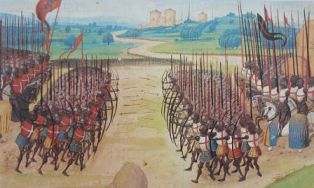 In the 11th century, Gascony in southwest France had been incorporated into Aquitaine (also known as Guyenne or Guienne) and formed with it the province of Guyenne and Gascony (French: Guyenne-et-Gascogne). The Angevin kings of England became Dukes of Aquitaine after Henry II married the former Queen of France, Eleanor of Aquitaine, in 1152, from which point the lands were held in vassalage to the French crown. By the 13th century the terms Aquitaine, Guyenne and Gascony were virtually synonymous.[7][8] At the beginning of Edward III's reign on 1 February 1327, the only part of Aquitaine that remained in his hands was the Duchy of Gascony. The term Gascony came to be used for the territory held by the Angevin (Plantagenet) Kings of England in southwest France, although they still used the title Duke of Aquitaine.[8][9]
For the first 10 years of Edward III's reign, Gascony had been a major point of friction. The English argued that, as Charles IV had not acted in a proper way towards his tenant, Edward should be able to hold the duchy free of any French suzerainty. However, this line of argument could not be maintained by the English, so in 1329 the 17-year old Edward III paid homage to Philip VI. Tradition demanded that vassals should approach their liege unarmed with heads uncovered, however Edward demonstrated his reluctance by attending the ceremony by wearing his crown and sword.[10] Despite Edward complying, albeit reluctantly, the French continued to pressure the English administration.[11]


No hay comentarios:
Publicar un comentario